Sound organises matter: why we begin with a plate of sand
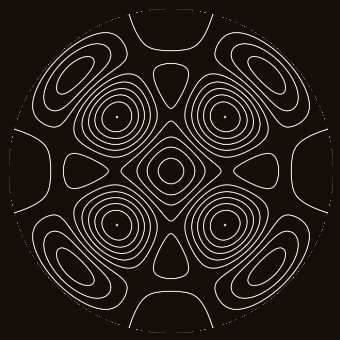
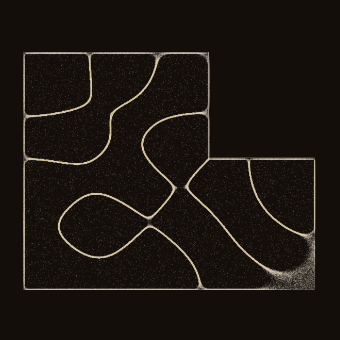
R13 Labs' design begins with a plate of sand because the plate shows, in one image, the idea the company is built on: sound can move things into a pattern. In 1787 the physicist Ernst Chladni bowed a metal plate dusted with sand, and the sand ran from the parts that shook to the lines that stayed still.
Every state has a pattern. Focus has one. So does calm, and so does a hotel lobby at 7 PM.
We build sound that works toward the pattern a person or a place needs. The plate is how we keep that idea in view.
What did Chladni discover?
Chladni published the experiment in 1787 in Entdeckungen über die Theorie des Klanges (Discoveries in the Theory of Sound). He mounted thin brass plates about 16 inches (40 cm) square, covered them with fine sand and set them ringing with a rosined bow (Linda Hall Library (opens in a new tab)).
As a plate vibrated, the sand moved to what Chladni called nodal lines: the places where the plate was not moving. Bow it at a different point, or rest a finger on the edge, and a different pattern formed. His book recorded hundreds of these figures as engravings, and they still carry his name.
The method needs nothing more than a plate, a bow and something fine to scatter. What it gave was a way to see how a surface vibrates.
Why did Napoleon put a prize on it?
In 1808 Chladni demonstrated his plates in Paris. On 27 February 1809 the Academy of Sciences announced a prize of 3,000 francs, approved by Napoleon, for a mathematical theory that could explain the patterns (a history of the prize, arXiv (opens in a new tab)).
The only entry came from Sophie Germain, a mathematician who had largely taught herself. Her first two submissions fell short; her third won in 1816, making her the first woman to receive the Grand Prize in Mathematics of the Paris Academy of Sciences (The Irish Times (opens in a new tab)).
Seeing the pattern took a bow and some sand. Explaining it took seven years to win the prize, and even then the judges called the work incomplete.
What does a plate of sand have to do with people?
Nothing literal. Sound doesn't arrange people the way it arranges sand, and we don't claim it does.
What the plate gives us is a picture of the job. Sand starts scattered, and the vibration finds the lines where it can settle. We build sound that starts loose, reads the signals it is given, and moves toward the state a person or a space needs; why we start from state rather than the clock or the weather is the subject of Context is not state.
It also moves only as far as it is sure. A system that reacts to every signal chases noise: the sound swells, drops and swells again, and you notice.
Our engine weighs every move by how sure it is. Unsure, it holds. Sure, it commits. The technology page sets out how that works.
Where did R13 Labs start?
It started with bass. Ridhwan Ahamed, R13 Labs' CEO, has loved loud sound with real vibration since he was young: a car that sounds right over one that is merely fast, and a wide taste in music with bass as the common thread.
That curiosity, not a billion-dollar thesis, is why he started building the engine: first for himself, then for the spaces around him. Sound you can feel is sound moving matter, which made a plate of sand the natural place to begin.
Today the same engine runs two products. Aqademiq is the calm study planner that helps students actually start. Prism Venues gives a space original sound, generated on a device in the venue and shaped across the trading day.
R13 Labs is built in Abu Dhabi and engineered in Coimbatore by three founders: Ridhwan Ahamed (CEO), Sri Hari Sai (CTO) and Zayaan Ali (COO).
How does the plate shape our design?
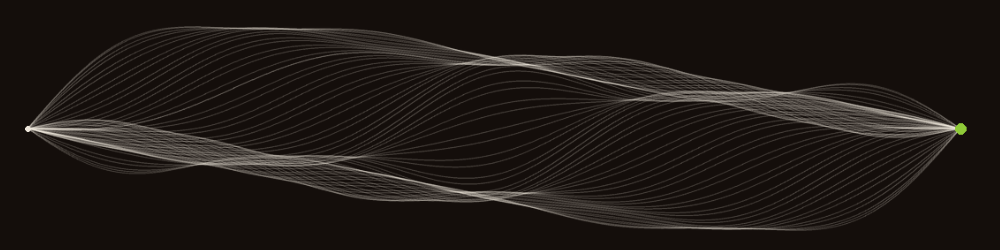
The plate is the image our visual language starts from: fine grain, still lines and a field that settles. Every article in this journal carries its own plate as its cover, drawn for that piece.
What the plate doesn't mean
In 1967 the Swiss physician Hans Jenny gave the study of these patterns a name, cymatics (Floris Books (opens in a new tab)). The images have been put to many uses since.
We use the plate for what it shows and no more: a vibrating surface, and grains of sand finding the lines that stay still. We don't claim that sound heals or that particular frequencies act on the body, and R13 Labs makes no medical claims. We don't claim brainwave entrainment either, for reasons set out in Do binaural beats work?
What we build on is better established. Sound shapes attention, arousal and mood (Thompson, Schellenberg and Husain, 2001 (opens in a new tab); Vasilev, Kirkby and Angele, 2018 (opens in a new tab)). Whether our engine does that better than a good playlist is not settled yet, and our science page sets out how we're finding out.
Frequently asked questions
What is a Chladni plate?
A Chladni plate is a thin plate, usually metal, scattered with sand and made to vibrate. The sand moves off the parts that shake and gathers on the nodal lines that stay still, drawing a pattern. Ernst Chladni published the method in 1787, and the patterns are known as Chladni figures.
What is cymatics?
Cymatics is a name for the study of the patterns vibration makes visible in sand, powders and liquids. The Swiss physician Hans Jenny coined it in 1967, building on Chladni's experiments. R13 Labs uses the Chladni plate as a design image, not as evidence of any effect on people.
Why does R13 Labs use a plate of sand in its design?
Because it shows the company's core idea in one image: vibration can move scattered material into a pattern. R13 Labs builds sound that moves toward the state a person or a space needs, and moves only as far as it is sure. Each article in its journal carries its own plate as its cover.
Does R13 Labs claim that sound can heal?
No. R13 Labs makes no medical or therapeutic claims and doesn't claim brainwave entrainment. It builds on what is established, that sound shapes attention, arousal and mood, and says plainly that whether its engine does this better than a good playlist is not settled yet.
Where is R13 Labs based?
R13 Labs is headquartered in Abu Dhabi, with engineering in Coimbatore. It operates through two companies: R13 Labs Limited in the Masdar City Free Zone, Abu Dhabi, and R13 Labs India Private Limited in Coimbatore, which is recognised by DPIIT under Startup India.
R13 Labs builds a real-time engine that shapes sound to the state a person or a space needs. The engine runs Aqademiq, a focus app on iOS and Android, and Prism Venues, original sound for every zone of hotels, cafes, clinics, stores and offices in India and the UAE. R13 Labs is based in Abu Dhabi and Coimbatore.
Join the team.
If sound, signal or the brain is your field, we'd like to see your work on our careers page.