
Do binaural beats work? Why we don't claim entrainment
The evidence is mixed, and the popular explanation is its weakest part. A 2019 meta-analysis found a medium-sized average effect of binaural beats on memory, attention, anxiety and pain, but a 2023 systematic review found only five of 14 EEG studies showing the brain falling into step with the beat.
R13 Labs doesn't claim brainwave entrainment. We haven't tested it, and the published evidence doesn't settle it.
What are binaural beats?
Binaural beats are a perception, not a sound in the room. Play one tone to the left ear and a slightly different tone to the right, and you hear a slow beat at the difference between them: 300 Hz and 305 Hz give a 5 Hz beat (López-Caballero and Escera, 2017 (opens in a new tab)).
The beat can be heard between about 1 Hz and 30 Hz, a range that overlaps the main frequency bands of the brain's electrical activity (Ingendoh, Posny and Heine, 2023 (opens in a new tab)). That overlap is where the appeal comes from. Because each tone has to reach one ear only, binaural beats need headphones.
Heinrich Wilhelm Dove first described the effect in 1839, and the biophysicist Gerald Oster revived interest in it with an article in Scientific American in 1973 (Oster, 1973 (opens in a new tab)).
What is brainwave entrainment?
Entrainment is the idea that rhythmic sound synchronises brain rhythms. Applied to binaural beats, the hypothesis is that stimulation at a given frequency leads the brain's electrical activity to oscillate at that frequency, and through it shifts how people think and feel (Ingendoh, Posny and Heine, 2023 (opens in a new tab)).
It is an attractive idea because it promises a dial: choose a frequency, get a state. The question is whether the brain follows.
What do the reviews find?
| Study | What it covered | What it found |
|---|---|---|
| Ingendoh, Posny and Heine, 2023 (opens in a new tab), PLOS ONE | 14 EEG studies of binaural-beat stimulation | Five consistent with entrainment, eight contradicting it, one mixed; designs too varied to compare well |
| López-Caballero and Escera, 2017 (opens in a new tab), Frontiers in Human Neuroscience | Beats at five frequencies, from 4.53 Hz to 57.3 Hz, in three-minute blocks | No change in EEG power, heart rate or skin conductance |
| Garcia-Argibay, Santed and Reales, 2019 (opens in a new tab), Psychological Research | 22 studies and 35 effect sizes on memory, attention, anxiety and pain | A medium average effect (g = 0.45) that depended on the beat frequency, how long people listened and when |
Read together, the three point two ways. Outcome studies find effects that swing with how the beats are used. The mechanism offered for those effects shows up in some EEG studies and not in others.
An effect without a dependable mechanism leaves other explanations open: a change in arousal or mood, the expectation of a benefit, or a steady sound masking a distracting one. None of those needs the brain to lock onto a beat.
What does sound reliably do?
Sound shapes attention, arousal and mood. That much is well established.
The best-known example is the Mozart effect. In 2001, Thompson, Schellenberg and Husain found that a lively Mozart sonata improved scores on a spatial test where a slow Albinoni adagio did not, and that the advantage disappeared once listeners' arousal and mood were held constant (Psychological Science (opens in a new tab)).
A 2010 meta-analysis of nearly 40 studies and more than 3,000 participants found little evidence of an effect specific to Mozart (Pietschnig, Voracek and Formann (opens in a new tab)). The music mattered through how it made people feel, not through anything special in its notes.
Sound can also cost attention. A 2018 meta-analysis of 65 studies found that background noise, speech and music all have a small but reliable cost to reading, with intelligible speech and music with lyrics costing the most (Vasilev, Kirkby and Angele (opens in a new tab)).
None of this needs entrainment. Sound changes arousal and mood, and it competes for attention. That is enough to matter, and it is what we build on.
Why doesn't R13 Labs claim entrainment?
Because we haven't tested it, and the published evidence doesn't settle it. We say what's established, what we're testing, and what we don't know.
Our engine is built to move sound toward a state, such as focus, calm or energy, and to move only as far as it is sure; why we start from state is the subject of Context is not state. We describe it in those terms and not in terms of brain frequencies. Aqademiq, the study planner that runs on the engine, makes no entrainment claim either.
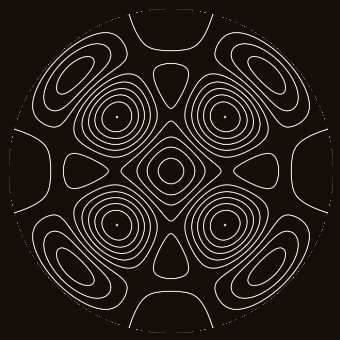
The same goes for the plate of sand at the centre of our design: we use it for what it shows and no more, as Sound organises matter explains.
What do we test instead?
We test two questions, because they can fail separately. Does the engine's read match reality? And does the sound move state the way it intends to?
Work is under way on the first, in the study context, and we'll publish what it finds. For the second, we plan to compare responsive sound with the same sound played without responding, and with static sound, so that a pleasant soundscape can't take the credit for responsiveness.
Whether our engine does this better than a good playlist is not settled yet. Until it is, we won't say it does.
Frequently asked questions
What are binaural beats?
Binaural beats are a slow beat you perceive when each ear hears a slightly different tone, such as 300 Hz in one ear and 305 Hz in the other. The 5 Hz beat exists only in perception, not in the air, which is why binaural beats need headphones.
Do binaural beats work for focus?
The evidence is mixed. A 2019 meta-analysis reported a medium average effect on memory, attention, anxiety and pain that varied with how the beats were used. A 2023 review found only five of 14 EEG studies showing the brain following the beat.
What is brainwave entrainment?
Brainwave entrainment is the idea that rhythmic sound synchronises brain rhythms, so that a beat at one frequency pulls the brain's electrical activity to the same frequency. R13 Labs doesn't claim it, because it hasn't tested it.
Does R13 Labs claim its sound changes brainwaves?
No. R13 Labs doesn't claim brainwave entrainment, medical benefit or certainty. It builds on what is established, that sound shapes attention, arousal and mood, and it publishes how it tests its own engine.
Is the Mozart effect real?
Not as an effect of Mozart's music in particular. A 2001 study found the spatial-test advantage after Mozart disappeared once listeners' arousal and mood were held constant, and a 2010 meta-analysis of nearly 40 studies found little evidence of a Mozart-specific effect.
R13 Labs builds a real-time engine that shapes sound to the state a person or a space needs. The engine runs Aqademiq, a focus app on iOS and Android, and Prism Venues, original sound for every zone of hotels, cafes, clinics, stores and offices in India and the UAE. R13 Labs is based in Abu Dhabi and Coimbatore.
Read the science.
What we've established, what we're testing and what we don't claim, on our science page.